Logic System loudspeaker products are designed to be used with the LS8Q and LS12Q four channel power amplifiers. Made for Logic System by Powersoft, they feature sophisticated power supplies, powerful DSP processing and Dante® as standard, in a 2u package. The rugged construction and Neutrik® connectors, allow use in touring or installation applications. The PFC (Power Factor Corrected) power supply allows operation on standard mains voltages, anywhere in the world. Powersoft’s SRM (Smart Rails Management) technology ensures electrical efficiency by only delivering the full rail voltage when the signal requires it to, which also reduces power draw (and heat dissipation) to less than 34W when idling. The powerful DSP can work with a 48 or 96kHz sampling rate, via an internal sample rate converter. Low and high pass filters up to 48dB/octave, plus parametric, all-pass and shelving type IIR filters are available, as well as up to 2048 tap FIR filters on each channel. In addition, Raised Cosine filters are also implemented, which are particularly useful for system tuning, due to their wide and narrow band equalisation flexibility. Audio inputs are provided by analogue, AES3, Dante® and AES67. The integrated gigabit Ethernet switch allows connection via star or daisy-chain wiring. Control of the LS amplifiers via Armonia+ can also be performed over the same Ethernet network. Usefully, the LS amplifiers can be used as an “on ramp” for converting analogue or AES3 input signals to Dante® or AES67 for audio distribution over a wired Ethernet network. LS amplifiers can be operated directly from the front panel, via the large colour touchscreen display, or over wired Ethernet, via the Armonia+ application. The amplifiers come pre-loaded with Logic System presets, for plug and play operation. The LS8Q can deliver peak output voltages up to +/-155V, with the more powerful LS12Q able to deliver an even greater +/-180V to maximise system headroom, when driving Logic System loudspeakers. Power output for both models is shown in the table below for a variety of symmetric/asymmetric loads, plus bridging options.
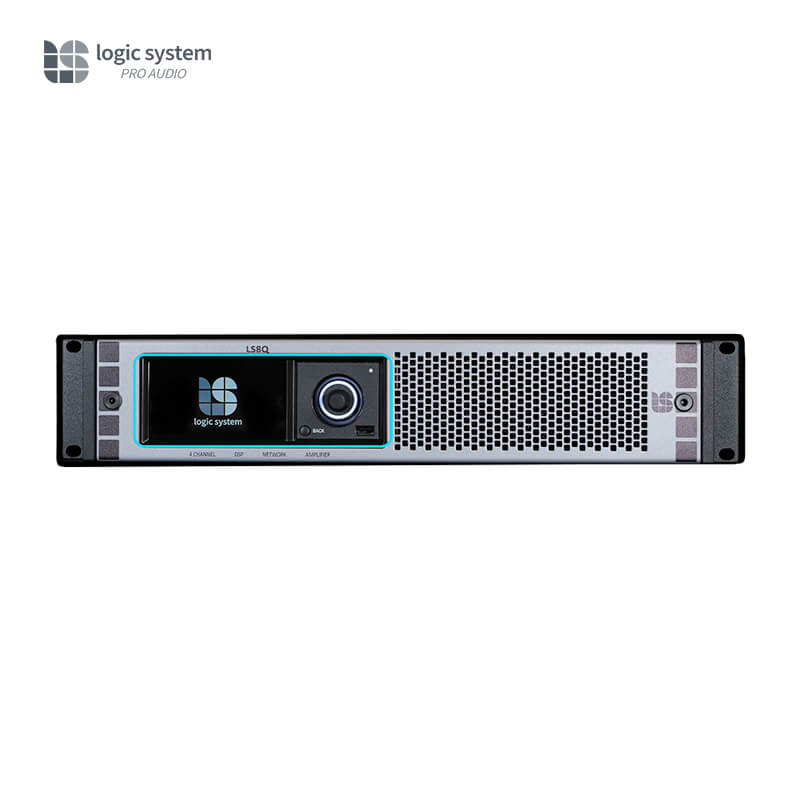
 LS8Q 12Q - Overview